Anticoagulants Lower Blood Clot Risk in Critically Ill Adolescents

visual bubble
visual bubble
visual bubble
visual bubble
Anthony A. Sochet, MD
01/09/2026

Critically ill children with prolonged lengths of stay, central venous catheterization, and concurrent infectious or parainflammatory processes have a high risk of hospital‐acquired venous thromboembolism (HA‐VTE).1,2
 
Read the source article for this feature from Pediatric Critical Care Medicine.

But no randomized controlled trials have evaluated thromboprophylaxis in critically ill children. Anticoagulation therapy is not routinely prescribed for critically ill children and adolescents, as it is for hospitalized adults.3,4 

“Blood clots are the second most common hospital-acquired condition in children next to bloodstream infections,”5 said Anthony A. Sochet, MD, a pediatric intensivist at Johns Hopkins All Children’s Hospital in St. Petersburg, Florida, USA, and associate professor at Johns Hopkins University School of Medicine. “That’s actually somewhat understated anecdotally, in the sense that the prevention of blood clots is not on the forefront of the minds of most intensivists who are working with children.”

Dr. Sochet and colleagues are working on producing trial-derived data for children, aiming to prevent HA-VTE. His latest findings were published in the September 2025 issue of Pediatric Critical Care Medicine.6

Currently, thromboprophylaxis use in children is based only on observational studies and anecdotal evidence. Dr. Sochet suspects that many clinicians try mechanical or nonpharmacological thromboprophylaxis (compression devices) first.3,4,7,8 “These devices are thought to work by squeezing your veins and, as a result, improving blood flow when you’re immobilized, reducing that potentially prothrombotic state,” he explained. “But there are some other beliefs too—and I say ‘beliefs’ because they’re not proven—that when you squeeze a vein, the cells that line the inside of the vein release endogenous anticoagulants into the bloodstream.9-12 We apply mechanical thromboprophylaxis in children and we have no idea if it’s efficacious and it may be distracting from measures like anticoagulants that are actually effective.”

The Findings
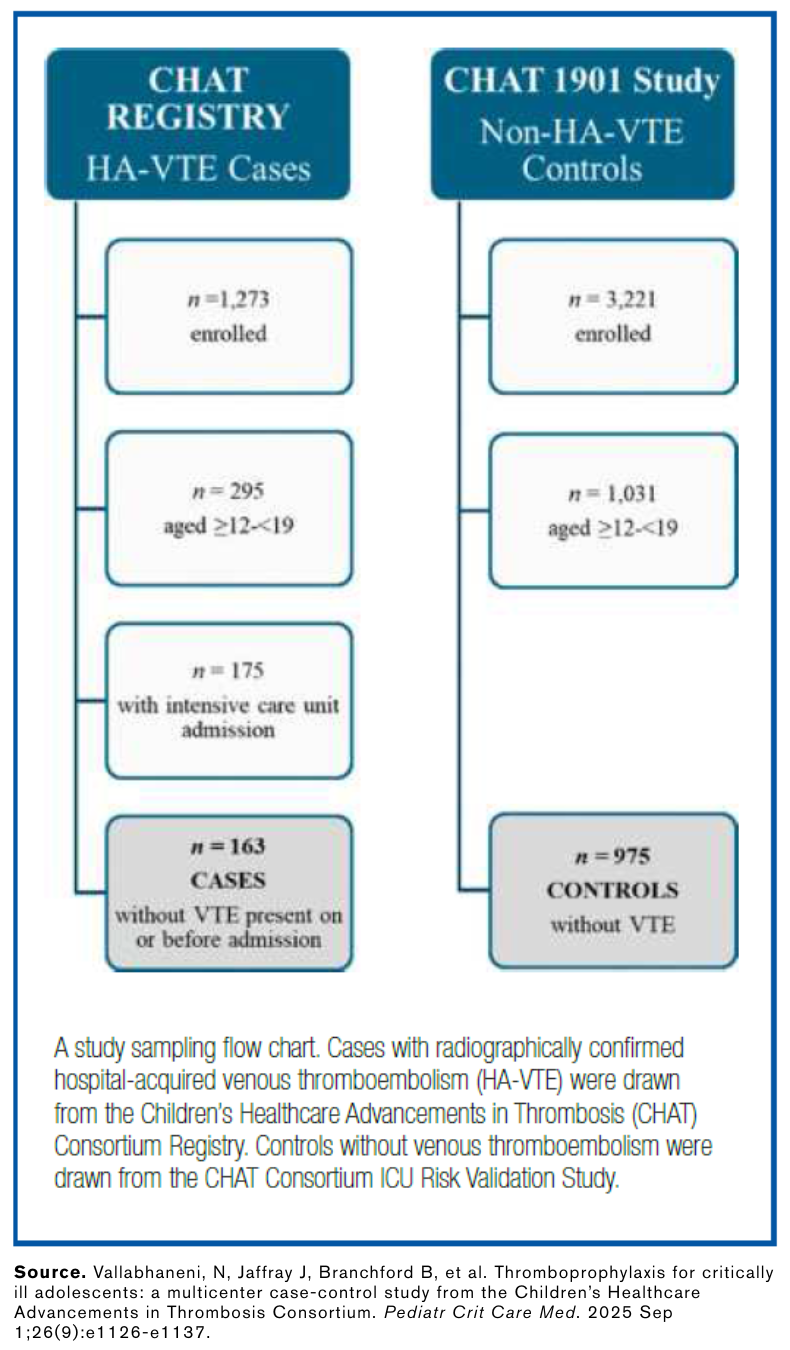
Dr. Sochet and the research team conducted a multicenter case-control study within the Children’s Healthcare Advancements in Thrombosis (CHAT) Consortium Registry and CHAT VTE risk-model validation study. They studied critically ill adolescents aged 12 to 19 from 32 North American pediatric intensive care units. They compared 163 patients with radiographically confirmed HA-VTE to 975 controls without HA-VTE. Compared with controls, patients with HA-VTE more frequently had central venous catheterization, invasive ventilation, longer median length of stay, impaired mobility, and infection.

Dr. Sochet said that younger children were not included in the study because adolescents are more likely to be prescribed compression devices with or without an anticoagulant and adolescents have higher rates of HA-VTE than other pediatric age groups.13,14

The researchers grouped the patients into predefined low, medium, and high risk of developing a VTE.1 The study found that the only therapy that prevented HA-VTE in all three risk groups was anticoagulants. The risk was lower in those who received pharmacologic thromboprophylaxis alone or in combination with mechanical thromboprophylaxis but not in those who received only mechanical thromboprophylaxis.

Dr. Sochet said of the study findings, “It may be that we are distracting ourselves in using mechanical thromboprophylaxis—because clinicians worried about bleeding risk sometimes say, ‘Oh, you know what, I’ll just apply mechanical thromboprophylaxis instead so that they don’t have a risk of bleeding and I get the same bang for the buck for preventing VTE.’ But the truth is, it’s more likely that we don’t actually prevent VTE with mechanical thromboprophylaxis and that we need to, instead, more proactively apply pharmacologic thromboprophylaxis.”

What’s Next
These findings could also apply to young adults, Dr. Sochet said. He noted that it is common in pediatrics to say that adolescents are not the same as young adults when it comes to treatments but, with blood clots, adults in their 20s and 30s are probably more similar to adolescents than to older patients. Most anticoagulant thromboprophylaxis studies in adults exclude people younger than 40 years and typically have a median age in the 60s.15-17 “When we try to extrapolate those trial data [on older patients] to people who are 20 to 25, we’re probably doing them a disservice because they’re more like children than they are like adults. This study probably is applicable to young adults who are also critically ill—and maybe more applicable than any of the adult data thus far.”


But Dr. Sochet cautioned that more trial data are needed in children and adolescents. “I don’t want to hang my hat on observational data, but in pediatrics, sometimes that’s the best we have,” he said. “The current best are these articles and a few others from our research group, which all show the same exact signal—that mechanical thromboprophylaxis is more of a distraction and that pharmacologic thromboprophylaxis is probably efficacious and that we need to be careful about which patients we apply it in.”14

Risk factors for HA‐VTE have been studied in multiple subpopulations, including pediatric trauma, oncology, critical illness, and cardiac intensive care.18-21 In every population, the biggest risk factor is having a central venous catheter,22 Dr. Sochet said. So it only makes sense that anticoagulants would be the most effective therapy, rather than mechanical compression. “If you have a central venous catheter, to me, it doesn’t make sense that anything but an anticoagulant would help. You could squeeze my leg, but if I have a catheter in my neck, I’m going to clot in my neck. When you’re critically ill, putting on a compression stocking or squeezing your legs is just not enough.”


A study sampling flow chart.

References

  1. Arlikar SJ, Atchison CM, Amankwah EK, et al. Development of a new risk score for hospital-associated venous thromboembolism in critically ill children not undergoing cardiothoracic surgery. Thromb Res. 2015 Oct;136(4):717-722.
  2. Mahajerin A, Croteau SE. Epidemiology and risk assessment of pediatric venous thromboembolism. Front Pediatr. 2017 Apr 10;5:68.
  3. Abrams CM, Jaffray J, Stillings A, et al; CHAT Consortium Investigators; VTE Risk Factors and Thromboprophylaxis Working Group of the Pediatric and Neonatal Thrombosis and Hemostasis Subcommittee of the ISTH SSC. Current practices in pediatric hospital-acquired thromboembolism: survey of the Children's Hospital Acquired Thrombosis (CHAT) Consortium. Res Pract Thromb Haemost. 2022 Dec;6(7):e12793.
  4. Faustino EVS, Hanson S, Spinella PC, et al; PROphylaxis against ThRombosis prACTice (PROTRACT) Study Investigators of the PALISI BloodNet. A multinational study of thromboprophylaxis practice in critically ill children. Crit Care Med. 2014 May;42(5):1232-1240.
  5. Sochet AA, Kiskaddon A, Betensky M, Goldenberg N. Venous thromboembolism among critically ill children: a narrative review. Semin Thromb Hemost. 2021 Sep;47(6):631-642.
  6. Vallabhaneni, N, Jaffray J, Branchford B, et al. Thromboprophylaxis for critically ill adolescents: a multicenter case-control study from the Children’s Healthcare Advancements in Thrombosis Consortium. Pediatr Crit Care Med. 2025 Jul 2. Online ahead of print.
  7. Bigelow AM, Flynn-O’Brien KT, Simpson PM, Dasgupta M, Hanson SJ. Multicenter review of current practices associated with venous thromboembolism prophylaxis in pediatric patients after trauma. Pediatr Crit Care Med. 2018 Sep;19(09):e448–e454. 
  8. Amos LE, Silvey M, Hall M, Witmer CM, Carpenter SL. Primary thromboprophylaxis in hospitalized children: a multi-center retrospective analysis. Thromb Res. 2019 Apr;176:1-7.
  9. Clarke RL, Orandi A, Cliffton EE. Induction of fibrinolysis by venous obstruction. Angiology. 1960 Oct;11:367-370.
  10. Allenby F, Boardman L, Pflug JJ, Calnan JS. Effects of external pneumatic intermittent compression on fibrinolysis in man. Lancet. 1973 Dec 22;2(7843):1412-1414.
  11. Salzman EW, McManama GP, Shapiro AH, et al. Effect of optimization of hemodynamics on fibrinolytic activity and antithrombotic efficacy of external pneumatic calf compression. Ann Surg. 1987 Nov;206(5):636-641.
  12. Chen AH, Frangos SG, Kilaru S, Sumpio BE. Intermittent pneumatic compression devices: physiological mechanisms of action. Eur J Vasc Endovasc Surg. 2001 May;21(5):383-392.
  13. Jaffray J, Mahajerin A, Young G, et al. A multi-institutional registry of pediatric hospital-acquired thrombosis cases: the children's hospital-acquired thrombosis (CHAT) project. Thromb Res. 2018 Jan;161:67-72.
  14. Betensky M, Vallabhaneni N, Goldenberg NA, Sochet AA. Mechanical thromboprophylaxis and hospital-acquired venous thromboembolism among critically ill adolescents: a U.S. pediatric health information systems registry study, 2016-2023. Pediatr Crit Care Med. 2025 Jan 1;26(1):e33-e41.
  15. Alameddine R, Husari A. Rivaroxaban for thromboprophylaxis in acutely ill medical patients. N Engl J Med. 2013 May 16;368(20):1944-1945.
  16. Cohen AT, Harrington RA, Goldhaber SZ, et al; APEX Investigators. Extended thromboprophylaxis with betrixaban in acutely ill medical patients. N Engl J Med. 2016 Aug 11;375(6):534-544.
  17. Spyropoulos AC, Ageno W, Albers GW, et al; MARINER Investigators. Rivaroxaban for thromboprophylaxis after hospitalization for medical illness. N Engl J Med. 2018 Sep 20;379(12):1118-1127. 
  18. Kiskaddon AL, Do NL, Amankwah EK, et al. Risks of incident venous thromboembolism, recurrent thromboembolism, and use of antithrombotic therapies among children with congenital heart disease undergoing cardiac surgery: a global multicenter analysis of real-world data. J Thromb Haemost. 2025 Mar 14;S1538-7836(25)00148-5.
  19. DeMayo KM, Havlicek EE, Betensky M, Goldenberg NA, Sochet AA. Hospital-acquired venous thromboembolism among critically ill children with diabetic ketoacidosis: a multicenter, retrospective cohort study. Res Pract Thromb Haemost. 2024 Oct 3;8(7):102581.
  20. Havlicek EE, Goldman ZA, Faustino EVS, Ignjatovic V, Goldenberg NA, Sochet AA. Hospital-acquired venous thromboembolism during invasive mechanical ventilation in children: a single-center, retrospective cohort study. J Thromb Haemost. 2023 Nov;21(11):3145-3152.
  21. Griffard J, Irons T, Xiao S, Martinez S, McNickle A, Kuhls D. Risk factors for deep venous thrombosis in pediatric trauma patients: a review of the National Trauma Data Bank from 2017 to 2022. J Trauma Acute Care Surg. 2025 Jul 3. Online ahead of print.
  22. Tran M, Shein SL, Ji X, Ahuja SP. Identification of a “VTE-rich” population in pediatrics: critically ill children with central venous catheters. Thromb Res. 2018 Jan;161:73-77.
 

Anthony A. Sochet, MD
Author
Anthony A. Sochet, MD
Anthony A. Sochet, MD, is a pediatric intensivist at Johns Hopkins All Children’s Hospital in St. Petersburg, Florida, USA, and associate professor at Johns Hopkins University School of Medicine.
Knowledge Area:

Recent Blog Posts

^