
Abstracts and Case Reports

Abstracts and Case Reports

Share your work and shape the future of critical care.


visual bubble
visual bubble
visual bubble
visual bubble

Submit your original investigative research abstracts and case reports for the 2027 Critical Care Congress and contribute to the advancement of critical care. The submission period ends Thursday, September 3, 2026, at 11:59 p.m. Central Time.


The 2027 Critical Care Congress will be held March 14-16, 2027, at the San Diego Convention Center in San Diego, California, USA. Connect, collaborate, and innovate at this premier event. Registration opens this summer. Sign up for alerts.

Why should you submit your abstract or case report?

  • Elevate your career. Have your work published in Critical Care Medicine, the leading journal in the field, and strengthen your professional portfolio.
  • Extend your influence. Present your findings, receive meaningful feedback, and connect with a diverse global audience of clinicians, researchers, and innovators.
  • Advance patient care. Your research and clinical observations help expand knowledge and improve outcomes across the critical care community.
  • Gain recognition. Compete for numerous awards and showcase your achievements, which is an excellent way to stand out on your curriculum vitae.

SCCM members enjoy complimentary abstract and case report submission for the Critical Care Congress. The fee for nonmembers is $45 per submission and is nonrefundable. Join Today 

General Information for 2027 Congress Submissions

Important Reminders About Your Submission

  • All abstracts and case reports must be in English.
  • First authors who are enrolled in an SCCM Sponsored Trainee program are required to submit their program director’s contact information:
    • Program director's name
    • Program type
    • Program institution
    • Program director's email address
  • An ethics and AI task that includes mandatory ethics and AI statements for the abstract and case report must be completed by the submitter on behalf of all authors associated with the submission.

Eligibility Requirements 

  • Abstracts, case reports, and/or data previously presented or published nationally or internationally are not allowed.
  • Abstracts and case reports presented at an SCCM chapter meeting are allowed.
  • Abstracts and case reports may contain new research on a topic presented previously.
  • Submission of an abstract or case report constitutes a commitment by the author(s) to present the abstract or case report as accepted at Congress.
  • Stimulating and unique abstracts or case reports will be considered for the 2027 Congress program.

Review Process

Revisions and Withdrawals

Accepted abstracts and case reports will be published as submitted in the March supplement to the journal Critical Care Medicine. SCCM does not edit or proofread abstracts or case reports. By saving each task you complete during the submission process, you can log off and return to continue your work at another time. You can edit and revise your abstract or case report online as much as you wish until the submission deadline. Once the abstract or case report is formally submitted and the submission system is closed, corrections can no longer be made. No edits or corrections will be made once the journal supplement is published.

Submissions may be withdrawn until 11:59 p.m. Central Time on October 30, 2026. All withdrawals must be submitted here.

Acceptance

The submitter, along with all authors on the abstract or case report, will be notified via email of the submission’s acceptance or rejection in October 2026. Please ensure that the first author’s email address is included with the submission. All further notifications and correspondence will be directed solely to the first author. It is the responsibility of the submitter to confirm that all author email addresses are current at the time of submission to ensure that any notifications sent by SCCM are received. All decisions made by the Congress Program Committee are final.

Expenses

  • Nonmembers are required to pay a $45 nonrefundable submission fee per abstract or case report submission.
  • Expenses associated with abstract or case report preparation, submission, and presentation are the responsibility of the presenter(s)/author(s).
  • Authors of accepted abstracts and case reports are expected to register for Congress and pay the registration fee.

 Important Dates

  • June 1, 2026: Submission period opens
  • September 3, 2026: Submission period closes at 11:59 p.m. Central Time
  • Summer 2026: Congress registration opens
  • October 2026: Notification of submission acceptance sent electronically to first author
  • November 2026: Notification sent to award recipients
  • March 2027: Online abstract and case report supplement published in Critical Care Medicine
  • March 14-16, 2027: Critical Care Congress at the San Diego Convention Center in San Diego, California, USA
Submissions

The submission period is open and ends September 3, 2026, at 11:59 p.m. Central Time.

How to Access the Submission Site

  1. To submit an abstract or case report for the 2027 Critical Care Congress, log in to MySCCM with your email address and password.
    1. If you create a new account, you will be directed to My Profile. To submit an abstract or case report, you will need to navigate back to the main MySCCM page by clicking MySCCM at the top of the page.
  2. Select OVERVIEW, then select Submit your 2027 Critical Care Congress abstract now.
  3. A new page will open automatically, bringing you to the abstract and case report submission site.

Step 1: Create Abstract or Case Report Submission

  1. By creating an abstract submission or case report, you confirm that the ethics requirements have been satisfied.
  2. Click here to begin a new submission.
  3. A new window will open.

Step 2: Title
The title should be entered in title case and contain 100 characters or less.

  1. The submission title header will contain a text field where you can type your text. You must complete all required fields. Required fields are denoted by a red asterisk (*).
  2. No images or tables will be accepted.

Step 3: Submission Format

  1. Select your submission format: Abstract or Case Report. Each submission format has different field requirements. Once you choose a format, you cannot modify it. If you need to modify it, you must create a new submission and choose a different format.
  2. Select either Abstract Submission or Case Report Submission.

Step 4: Submission Category

  1. Select your submission category from the drop-down menu.
  2. Click Submit.
  3. If successfully submitted, the message "New submission was successfully added" will appear.

Step 5: Content

  1. Click here to add the details of your submission. Do not use HTML, bullets, images, or tables.
  2. Enter the title of the submission again.
  3. Enter content into the appropriate fields.
    • Abstract fields: INTRODUCTION/HYPOTHESIS, METHODS, RESULTS, AND CONCLUSIONS
    • Case Report fields: INTRODUCTION, DESCRIPTION, AND DISCUSSION

Step 6: Authors

  • As the submitter, you will be asked to select a role for each author you add to the submission. 
  • Nonmember submitters will be required to pay a $45 submission fee.
  • To add the first author, click Author Lookup and a search box will appear.
    • Enter the first name, last name, and institution, then click Search.
    • If the author is in the system, the name will appear in the search results.
    • Once you select the appropriate name, click Add Author.
    • Select the first author role.
    • Click Add Author to add that author to the submission.
    • If you see "Profile incomplete" after adding an author, click Edit Profile and complete the following fields: Professional Title, Institution, and Credentials.
    • If the author is not in the system, enter the first name, last name, email address, and role.
      • Click Add Author. Note: The author will be added to the submission and you will be required to complete the author’s profile.
      • The following message will appear: "Thank you for adding a new Author." You can click their name to edit their details.
      • Complete the profile by adding their professional title, institution, and credentials.
  • If you wish to add additional authors, click Member Lookup or Add Author.
    • Note: Please make sure that you have searched for an existing author account before creating a new author account by clicking Add Author. Only individuals can be listed as authors (not organizations or groups).
    • If the author is not in the system, enter the first name, last name, email address, and role.
    • Click Add Author. Note: The author will be added to the submission, and you will be required to complete the author’s profile.
    • The new author is displayed under the Author List.
    • The order of authors can be changed. To adjust the order, use the arrows to the right of the screen to arrange the names accordingly.
  • When finished with the Author List, select Save Authors.

Please ensure that the submitter’s email address is included with the submission. All notifications and correspondence will be directed to the first author.

Each author must have a unique email address. Email addresses cannot be shared among multiple authors.

Please note: Make sure the correct individual is identified as the first author of the abstract or case report. Ensure that the authors are listed in the correct order, with the first author listed first. The order in which authors are listed at the time of submission is final and cannot be changed after the submission system is closed. Make sure to double-check that this information is correct.

Step 7: Categories

  • Complete all the required tasks pertaining to your submission (Classification, Patient Type, Categories, Keywords, and Ethics).
  • Click Continue.

Step 8: Ethics Agreement

  • Confirm the ethical statement by clicking "I agree."
  • Click Save.

Step 9: Program Director Information Form

  • If the first author is not in a training program, select No, click Save, and move to the next task.
  • First authors enrolled in an educational program must complete a Program Director Information form. If you are not the first author but are the submitter, you must complete the form on the first author’s behalf.
  • The Program Director Information Form will request the following information:
    • First author's full name
    • Abstract or case report title
    • Program director's name
    • Program type
    • Program institution
    • Program director's email address
  • Click Save.

Step 10: Congress Scholarships (Abstract Submissions Only)

  • Click on the Congress Scholarship task and review the criteria, then answer the question: Do you meet these criteria?
    • If you select No, click Save and move to the next task.
    • If you select Yes, complete the task in its entirety.

Step 11: Abstract Award Applications (Abstract Submissions Only)

  • Select Yes if you are applying for one of the following awards:
    • SCCM In-Training Award
    • SCCM Early-Stage Researcher Award
    • SCCM Hector R. Wong Award for Precision Medicine in Sepsis
    • Clinical Pharmacy and Pharmacology Section: Patient Safety and Early-Stage Researcher Award
    • Clinical Pharmacy and Pharmacology Section: Innovations in Patient and Medication Safety Award
  • Please note: You must be an SCCM member and first author of an abstract to be considered. If you are applying for any of the first three awards, you must provide an uploaded document in the next task to be considered.
  • If you are not applying for these awards, click Save and proceed to the next task.

Step 12: Abstract Award Application Upload(s)

  • Click the OPT OUT statement if you are not applying for an abstract award that requires a verification letter.
    • Click Continue and move to the next task.
  • A verification letter on official letterhead signed by a program director must be uploaded by September 3, 2026. The letter must include the applicant's name, abstract title, qualifying criteria, dates of fellowship/training, and director’s name.
  • Upload a verification letter for the following awards:
    • In-Training Award
    • Early-Stage Researcher Award
    • Clinical Pharmacy and Pharmacology Section: Patient Safety and Early-Stage Researcher Award
  • Click Continue to move to the next task.

Step 13: Submit and Preview Submission
Preview allows you to review the information entered during each task of the submission process.

  • Ensure that all steps are complete, as indicated by the green check mark in each task. If a task appears red, you missed a step in that section.
  • Once you click Save Submission, you have finalized your abstract or case report.
  • Click "Click here for a preview of your submission."
  • Review your submission information. If any information needs to be updated or contains errors, go back to the corresponding task. You may return to your submission to modify any section at any time while the submission site is still open.
  • Click Previous at the top of the screen to return to your submission.
  • Click Submit to finalize your submission.
  • A thank-you message will appear on the screen, followed by a confirmation email to the first author associated with the submission.
  • If your abstract is accepted after peer review, it will be published as submitted in a supplement to the journal Critical Care Medicine.
Formatting

All submissions should conform to the following content structure and formatting guidelines. Failure to follow these guidelines will result in a low score and may cause your submission to be disqualified.

View Term Abbreviations

Abstracts

  • Each submission is limited to a total of 2400 characters, including spaces. Each section of the abstract has a character limit. The body may contain 2300 characters. The title may contain 100 characters and should be in title case.
  • There is a limit of 20 authors.
  • Complete all subheading fields:
    • INTRODUCTION/HYPOTHESIS
    • METHODS
    • RESULTS
    • CONCLUSIONS
  • The abstract may not contain tables or images.
  • Phrases such as “Results/methods will be discussed” and “Additional data will be presented” convey no relevant information and are unacceptable.
  • The abstract cannot contain any HTML codes. To avoid formatting inconsistencies, please do not copy and paste text directly from Microsoft Word. Instead, paste the content into a plain text editor (such as Notepad), then transfer the content from there.
  • Do not use all uppercase for the abstract content. Turn off the caps lock feature.

View a Sample Abstract

Case Reports

  • Each submission is limited to a total of 2400 characters, including spaces. Each section of the case report has a character limit. The body may contain 2300 characters. The title may contain 100 characters and should be in title case.
  • There is a limit of 20 authors.
  • Complete the following fields:
    • INTRODUCTION
    • DESCRIPTION of the case
    • DISCUSSION of the originality and importance of the case
  • The case report cannot contain any HTML codes. To avoid formatting inconsistencies, please do not copy and paste case text directly from Microsoft Word. Instead, paste the content into a plain text editor (such as Notepad), then transfer the content from there.
  • The case report may not contain tables or images.
  • Please do not use all uppercase in the case report content. Turn off the caps lock feature.

View a Sample Case Report

Awards for 2027 Congress Submissions

Nomination-Based Awards
On acceptance, your abstract or case report may be considered for an award. Abstract- and case report-based awards are given to the first author of the abstract or case report. All authors of an abstract or case report will be notified if their submission receives an award. For more information, contact SCCM Customer Service.
 
Star Research Award Recipients
The top-scoring abstracts are selected for Star Research Presentations in Connections Central (Exhibit Hall). From these selected abstracts, the In-Training and Early-Stage Researcher awards are given. These awards require an application. Applications are available online within the abstract submission system. Recipients of the In-Training and Early-Stage Researcher awards receive $2,500 and a personalized commemorative plaque.

Early-Stage Researcher Award: Criteria

  • Applicant must have completed a training program at least 18 months (but not more than three years) before February 2027.
  • Applicant must complete the application and upload a verification letter on official letterhead signed by a program director by September 3, 2026. Please include the abstract title.

In-Training Award: Criteria

  • Applicant must be in a critical care training program or have ended training not more than one year before Congress.
  • Applicant must complete the application and upload a verification letter on official letterhead signed by a program director by September 3, 2026. Please include the abstract title.

From the remaining abstracts, the following awards are given:

  • Gold Medal Award: This is awarded to the applicant with the highest abstract score of the remaining submissions. Only one Gold Medal Award is given per year. The awardee receives $2,000 and a commemorative plaque and should consider submitting the manuscript for publication in Critical Care Medicine.
  • Silver Medal Award: This is awarded to the applicant with the second-highest abstract score of the remaining submissions. Only one Silver Medal Award is given per year. The awardee receives $1,000 and a commemorative plaque and should consider submitting the manuscript for publication in Critical Care Medicine.
  • Bronze Medal Award: This is awarded to the applicant with the third-highest abstract score of the remaining submissions. Only one Bronze Medal Award is given per year. The awardee receives $500 and a commemorative plaque and should consider submitting the manuscript for publication in Critical Care Medicine.
  • The recipients of the Gold, Silver, and Bronze Medal Awards are not eligible to receive the Early-Stage Researcher or In-Training awards.
  • The remaining submitters in this category receive a Star Research Award certificate of achievement and $100.

Research Snapshot Awards
Authors of abstracts that were not accepted for Star Research Presentations make short presentations facilitated by a moderator in the Research Snapshot Theaters in Connections Central (Exhibit Hall). Additionally, the abstracts with the top 30 scores in this category receive the following awards:

  • Gold Snapshot Award: This is awarded to 10 people per year with the highest-ranking abstracts in this category. The awardee receives a certificate.
  • Silver Snapshot Award: This is awarded to 10 people per year with the highest-ranking abstracts in this category. The awardee receives a certificate.
  • Bronze Snapshot Award: This is awarded to 10 people per year with the highest-ranking abstracts in this category. The awardee receives a certificate.

Case Report Snapshot Awards
Authors of accepted case reports make short presentations facilitated by a moderator in the Research Snapshot Theaters located in Connections Central (Exhibit Hall). Additionally, the top three case reports receive the following awards:

  • One First-Place Award certificate
  • One Second-Place Award certificate
  • One Third-Place Award certificate

Hector R. Wong Award for Precision Medicine in Sepsis
First authors of abstracts submitted in the precision medicine in sepsis category who are SCCM members will be considered for this award. The award recipient will be recognized during the Abstracts Award Presentation at Congress and will receive a plaque and $1000.

Congress Scholarships
SCCM specialty sections offer a $500 scholarship for a section member. The application is completed during the submission process. The applicant must:

  • Be an SCCM member
  • Be a member of the section to which the applicant is applying
  • Be an early-career investigator
  • Attend the 2027 Congress
  • Be the first and presenting author of an accepted abstract
  • Be multidisciplinary, if multiple recipients

Additionally, the research should:

  • Support emerging science in the applicant’s specialty
  • Demonstrate excellence based on the submission’s score
  • Demonstrate the importance of the work to critically ill patients and families
  • Be relevant to the section specialty

Members of the section leadership are ineligible to apply for the scholarship.

Clinical Pharmacy and Pharmacology Section Awards

Patient Safety and Early-Stage Researcher Award: Criteria

  • Applicant must be a pharmacist who is in residency or fellowship training or who has completed training within five years before the application date.
  • Applicant must be a member of the SCCM Clinical Pharmacy and Pharmacology (CPP) Section, be the first author of the submitted project, and have no current employment with the pharmaceutical industry.
  • Multiprofessional collaboration with physicians, nurses, information technologists, administrators, and other healthcare professionals is welcome and strongly encouraged.
  • SCCM members who have served as chair or chair-elect of the SCCM CPP Patient Safety Committee or who have served on the SCCM CPP Steering Committee are not eligible to apply until three years after their term has ended. These members must also not be senior authors on submitted abstracts.
  • Collaboration on the project with an SCCM member who has served as chair or chair-elect of the SCCM CPP Patient Safety Committee or who has served on the SCCM CPP Executive Committee does not affect the eligibility of an applicant who meets all other criteria.
  • Applicant must upload a verification letter on official letterhead signed by a program director or current employer by September 3, 2026. The letter must include the applicant’s name, abstract title, qualifying criteria, dates of fellowship/training, and director’s name.

Innovations in Patient and Medication Safety Award: Criteria

  • Applicant must be a pharmacist who is a member of the SCCM Clinical Pharmacy and Pharmacology (CPP) Section, be the first author of the submitted project, and have no current employment with the pharmaceutical industry.
  • Multiprofessional collaboration with physicians, nurses, information technologists, administrators, and other healthcare professionals is welcome and strongly encouraged.
  • SCCM members who have served as chair or chair-elect of the SCCM CPP Patient Safety Committee or who have served on the SCCM CPP Steering Committee are not eligible to apply until three years after their term has ended. These members must also not be senior authors on submitted abstracts.
  • Collaboration on the project with an SCCM member who has served as chair or chair-elect of the SCCM CPP Patient Safety Committee or who has served on the SCCM CPP Executive Committee does not affect the eligibility of an applicant who meets all other criteria.
Abstract and Case Report Reviewers

Eligibility Requirements for Abstract and Case Report Reviewers

  • Be an SCCM member
  • Have three years of experience in critical care
  • Be a published author
  • Be able to review 20 to 30 abstracts or case reports in September 2026
Frequently Asked Questions

Submission

Can I submit more than one abstract or case report?
Yes, you may submit multiple abstracts or case reports. Each submission must be completed separately and meet all requirements.

Is there a submission fee?
SCCM members enjoy complimentary abstract and case report submission for the Critical Care Congress. The fee for nonmembers is $45 per submission and is nonrefundable.

What are the format and word count requirements?
Formatting guidelines and word count limits are provided within the submission site. Please review these instructions carefully before submitting.

Is there a limit to the number of authors?
Yes, a maximum of 20 authors may be listed. This limit is outlined in the Author section of the submission site.

Can a submission be made under an organization’s name?
No. Submissions must be made under the name of an individual, not an entity or organization.

Can I save my submission and finish later?
Yes, you can save your progress and return before the deadline.

How can I confirm that my submission was received?
You will receive a confirmation email once your submission is complete. The email will include your submission ID, author list, and abstract or case report details.

Can I edit my submission after submitting it?
Yes, you may edit your submission at any time before the submission deadline, even after it has been submitted.

Can I add or change authors after submitting?

  • Add an author: Yes, authors may be added up until the submission deadline.
  • Change the first author: Yes, the first author can be changed before the submission deadline, but not after. If the change relates to presentation at Congress, a presenter change form may be submitted.

Can I withdraw my submission?
Yes, submissions can be withdrawn prior to the review or acceptance decision. Instructions are available in the submission system.

Can I submit or present my abstract or case report elsewhere?
No. Abstracts or case reports that have already been published or presented at another association are not eligible for SCCM’s Congress.

How are submissions reviewed?
Submissions are peer-reviewed based on criteria such as originality, scientific quality, and relevance to critical care.

Presentation

How do I upload my presentation if accepted?
If your submission is accepted, a link to the Speaker Ready Room will appear in your My SCCM account, where you will complete speaker tasks and upload your presentation materials.

Do I need to register for Congress to present?
Yes, all presenters must register for Congress.

Can I invite a guest to view my presentation?
Yes, guests and children may visit Connections Central (Exhibit Hall) where presentations are held but must always be accompanied by a registered Congress attendee. Please visit the Help Desk on site to obtain a guest badge.
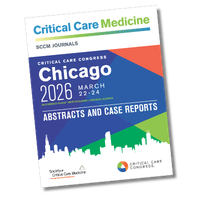

2026 Critical Care Congress Abstracts and Case Reports

2026 Critical Care Congress Abstracts and Case Reports

Over 1700 abstracts and case reports were accepted for the 2026 Critical Care Congress.

View the Supplement Published in Critical Care Medicine

^