SCCM’s ICU Heroes Award recognizes that patients and families are an integral part of critical care. Priscilla Timmons, Mathias Uribe, and their respective ICU teams are the recipients of this year's award.
The Society of Critical Care Medicine’s (SCCM) ICU Heroes Award recognizes that patients and families are an integral part of critical care. The award is presented to an intensive care unit (ICU) patient, their family, and the multiprofessional team that delivered the care. Two awards are presented each year: one for an adult ICU patient and one for a pediatric ICU (PICU) patient.
Priscilla Timmons and Mathias Uribe both have a newfound appreciation for time—not the abstract notion of it but the reality of how quickly life can change. Priscilla, 38, was resuscitated for 41 minutes after a massive pulmonary embolism (PE) led to shock, multiorgan failure, and three cardiac arrests. Mathias was 14 when his condition was misdiagnosed at a pediatrician’s office. After two visits to the pediatrician’s office and a phone call by his father later, four days after the first visit, Mathias was rushed to the emergency department, where he had shock and cardiac arrest. He was resuscitated, spent 12 days on extracorporeal membrane oxygenation (ECMO), and had 23 surgeries. Today, both Priscilla and Mathias say they are doing great, thanks to the care they received from their ICU teams.
Not Losing Hope
Priscilla had a 10-year history of deep vein thrombosis. On March 13, 2025, she was visiting her mother when her stomach began to hurt and she suddenly felt nauseous. She was walking to the bathroom when her body began to tingle and everything went dark. “I knew I was going down,” Priscilla said. “I immediately grabbed on to the bathroom counter and helped ease my body onto the floor. Thankfully, my phone was in my other hand, so when I lay on the bathroom floor, I was able to see again, and I mustered up all the strength I had to text my mom, ‘Mom, help. Call 911. Going to pass out. In the bathroom.’”
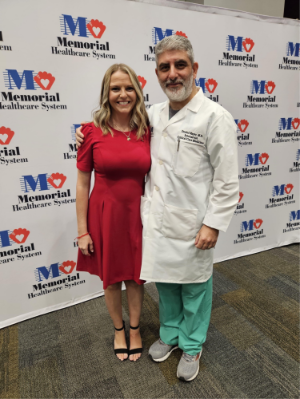
Priscilla Timmons with Memorial Hospital West ICU Director Daniel Mayer, MD. |
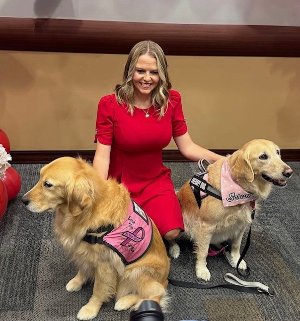
Priscilla Timmons and the Memorial Hospital West therapy dogs, Honey and Scrunchie. |
Priscilla was rushed to Memorial Hospital West in Pembroke Pines, Florida. Her left leg was swollen, and she was tachycardic, tachypneic, and hypotensive. ICU Director Daniel Mayer, MD, saw her for the first time in the emergency department. “She was in shock and looked ashen,” Dr. Mayer said. “I was deeply concerned about her because of the high mortality associated with massive PE and the potential for further decompensation.”
Shortly after Priscilla was admitted to the ICU, she had a cardiac arrest and was intubated. She had intermittent episodes of return to spontaneous circulation but then had two more cardiac arrests. She underwent 41 minutes of cardiac resuscitation.
“Most patients who are in cardiac arrest this long have irreversible brain anoxia or damage, so most times a resuscitation team would not prolong the resuscitation attempt like this,” Dr. Mayer said. “In Priscilla's case, she was young and otherwise healthy, so I persevered as long as I could. I was assisted by an amazing ICU team who provided optimal advanced cardiovascular life support without once tiring or giving up.”
Although brain damage was averted, Priscilla had respiratory, renal, hepatic, and hematologic failure. Several days later, Priscilla began to respond—thanks in part to two furry friends. The Memorial Hospital West care team includes two therapy dogs, Scrunchie and Honeycrisp. They provide comfort and affection to patients and their families. They can also offer meaningful benefits to patients who are unresponsive or minimally responsive, Dr. Mayer said.
That was what happened for Priscilla. “Off sedation, Priscilla was slow to wake up and respond,” Dr. Mayer said. “The family requested our therapy dogs interact with her, and in response to a couple of dog kisses to her hand, she began reanimating.”
Priscilla remembers those first kisses. “Scrunchie and Honey both brought my personality out, which showed everyone I was still there, my brain was intact, and I was going to be okay,” she said. “They both brought that special reassurance to me that I was in good hands.”
Priscilla spent nine days in the ICU. Dr. Mayer said that her recovery is a testament to her ICU care team who showed vigilance, teamwork, and compassion under pressure. “The ICU team was there every moment, not just providing medical care, but offering hope, comfort, and strength when it was needed most to the patient, her family, and each other,” he said. “That kind of dedication leaves an indelible mark on patients, on families, and on all of us clinicians who witness it.”
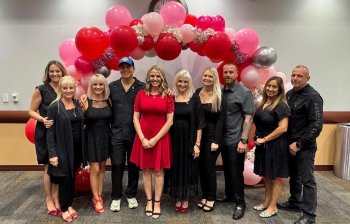
Priscilla Timmons and her family. |
That dedication is not accidental. Memorial Hospital West prides itself on being a patient- and family-centric hospital where collaboration and collegiality are more important than individual job responsibilities. This is why Dr. Mayer is honored to share the ICU Heroes Award not just with Priscilla and her family, but also with the entire care team. “Having an outcome as in Priscilla’s case reaffirms why we do what we do,” he said. “The ICU Heroes Award bestows recognition to each member of the ICU team, recognizing how important each member is in patient care. For me, the award recognizes that we are a mission-driven medical family, and each member of that family is essential for optimal patient outcomes.”Priscilla agrees with Dr. Mayer. “It’s so important that this award is shared between both patients and their care team because it shows the connection,” she said. “It gives the motivation for care teams to fight for their patients, and it gives hope to the patients to fight for their life and for both to not lose hope and faith along the journey. I can’t thank Dr. Mayer and the entire ICU team at Memorial West enough for fighting for me. They are all the real ICU heroes.”
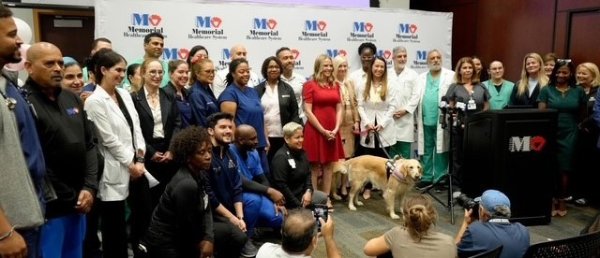
Priscilla Timmons and the Memorial Hospital West ICU team. |
Refusing to Give Up
In June 2023, Mathias was misdiagnosed with influenza. Among other symptoms, he had a full-body rash. Even though he had been evaluated at his pediatrician’s office twice within three days, he had not been tested for
Streptococcus, and his scarlet fever had not been diagnosed. His father, Edgar Uribe, called the pediatrician’s office on the fourth day to tell them that Mathias was worse, but the office staff told him it was fine for Mathias to stay at home.
The next day, Mathias’ father took him to the emergency department at their local hospital. Mathias collapsed with shock and cardiac arrest. He was diagnosed with group A
Streptococcus sepsis and pneumonia and transported by helicopter to a nearby hospital with a PICU, where physicians told Mathias’ parents that their son needed ECMO. The only problem? ECMO was not available at that hospital.
Mathias was transported again, this time to Monroe Carell Jr. Children’s Hospital at Vanderbilt University in Nashville, Tennessee. Before Mathias was transported, physicians warned that he had a 1% chance to live. The
Streptococcus infection had caused tissue damage to all his extremities. At Vanderbilt, he was started on ECMO.
Mathias had already been in the PICU for several days when Medical Director Kristina Ann Betters, MD, FAAP, FCCM, first saw him. Her assessment was dire. “We were not sure he would survive,” Dr. Betters said.
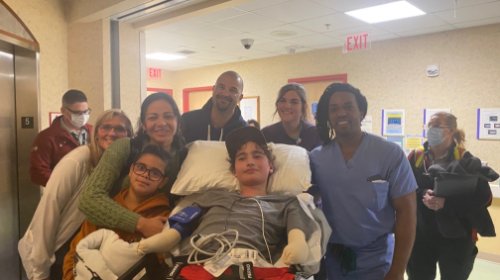
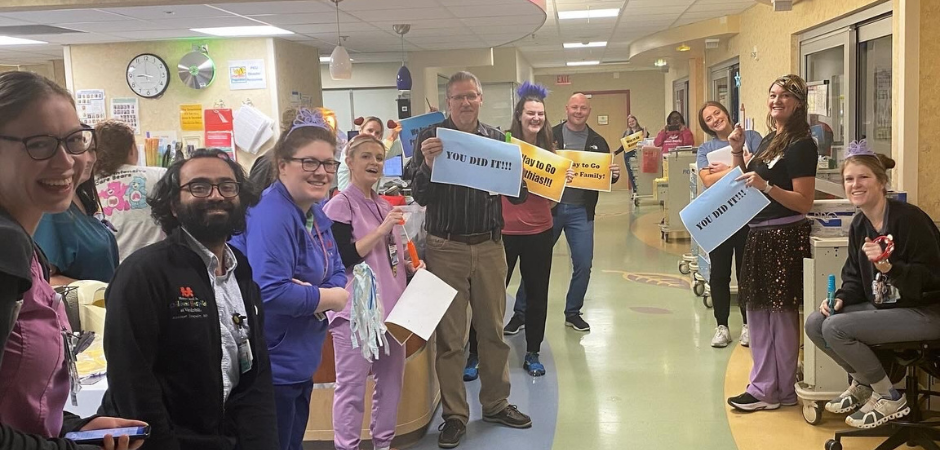
Mathias Uribe, his family, and members of his care team at Monroe Carell Jr. Children’s Hospital at Vanderbilt. |
Mathias spent 12 days on ECMO and five months in the PICU. He required four amputations and spent another five months in a rehabilitation hospital in Chicago. He could have given up, but he didn’t—thanks in large part to the support he had from his family and his extensive care team. “His story is unique due to the multidisciplinary care required to care for him, the invaluable support his parents and family provided him, and his remarkable resiliency,” Dr. Betters said. “His physical recovery is nothing short of amazing, but his ability to recover from the psychological trauma of his injury is astounding.”
Vanderbilt’s rehabilitation team was key to Mathias’ physical recovery. Psychology, psychiatry, child life, spiritual, and social work teams all contributed to his psychological recovery. Dr. Betters credited her colleagues, as well as Mathias and his family, for making Mathias’ survival possible.
Today, Mathias is 17 and learning to live with prosthetics. He has an adaptive controller to play video games with his friends and adaptive controls in his car. “I feel a lot of freedom now that I can drive,” Mathias said. He is thinking about college now. He always wanted to be an engineer, and his recovery inspired an interest in biomedical engineering. “This experience really opened my eyes,” he said. “It would be so fulfilling to help people like me and develop things that would facilitate great lives for people for whom, right now, it seems like their life’s over. I hope I can change that.”
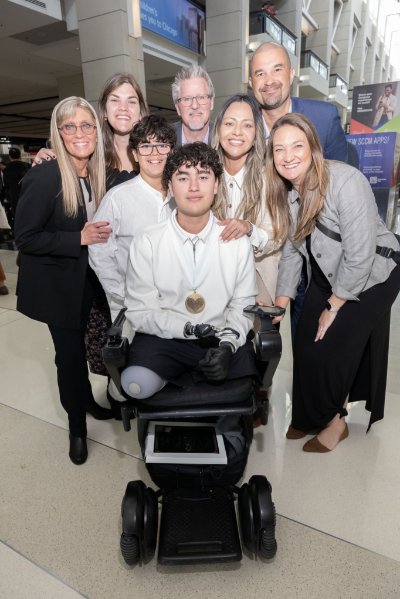
Mathias Uribe, his family, and members of his care team. |