



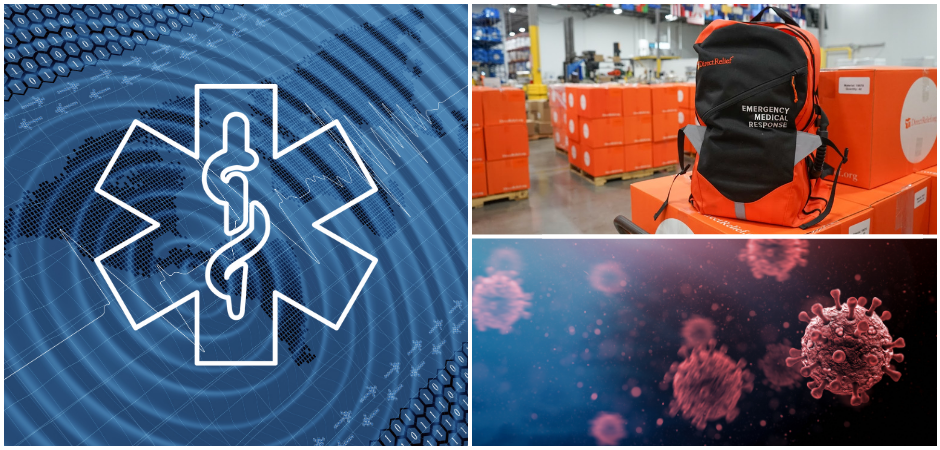
How to Inform the ERT If your hospital or region is experiencing a crisis, please contact SCCM's ERT at emergency@sccm.org. This resource is available to both SCCM members and nonmembers, as well as organizations interested in supporting relief efforts.
This information is essential for SCCM’s collaboration with partner organizations and key stakeholders to coordinate relief efforts, facilitate resource distribution, and support life-saving care. |
Initial Crisis Response Plan Activation
It is relevant to understand and follow the process when SCCM becomes aware of an emergency event that may require the need for assistance and support.
Once SCCM’s ERT is aware of a disaster, the sequence begins when the SCCM President and SCCM CEO approve the activation of the emergency response plan, which alerts the ERT.
After the crisis response plan is activated, co-leads including the Vice President of Global Health, Publications, and Philanthropy and Vice President of Marketing, Sales, and Communications (with the support of the Associate Director, Philanthropy) direct the response:
Sustained Response
A sustained crisis may need further response, and the ERT may determine that further email communication to the membership and to the affected areas is needed. SCCM may also send a request for donations to support the needs of the impacted area—this email specifically excludes those in the impacted region. Social media communiqués will complement email and website activity to help garner relief aid and donations to support these activities. When funded by an external organization during sustained crises such as the conflict in Ukraine, SCCM may receive a request for training sessions that address critical clinical care needs. These requests may span from critical care fundamentals to more advanced POCUS training to evaluate intravascular volume, the presence of intra-cavity fluid, or cardiac performance. Current and previous ongoing crisis response efforts can be found at sccm.org/response.
Volunteering to Provide Clinical Care
In emergencies, such as the COVID-19 pandemic when SCCM helped deploy around 1,000 volunteer clinicians, the most critical resource was not only medical supplies but also trained healthcare professionals. Volunteer clinicians were essential for staffing both existing and newly established ICUs, as well as other patient care sites.
Requests for an organized call for volunteers to travel on-site must originate from a governmental authority or another entity with the legal authority to oversee medical licensure and credentialing. For international deployments, requests must come through the government of the affected country to ensure appropriate authorization for volunteer participation.
If requested by governments, nonprofit organizations, or hospitals, SCCM will identify and contact clinician experts whose consultation can guide the broader emergency response process with concepts to improve and expand the provision of care during the crisis.
SCCM works directly with the requesting agency to recruit qualified volunteer clinicians from the critical care community who meet the specific needs of the response effort. Additional information on how to request an official call for volunteers is available at sccm.org/response.
Conclusion
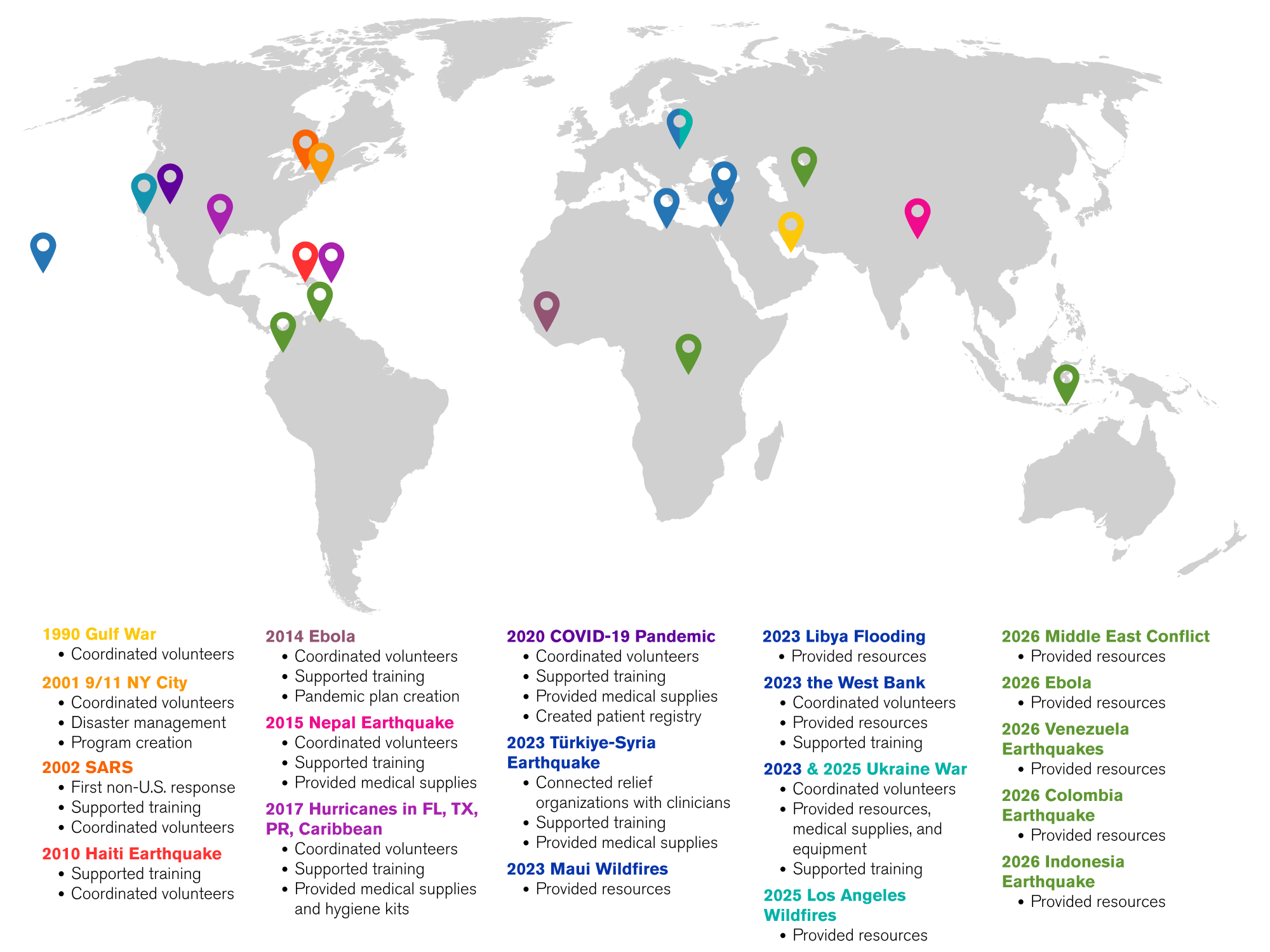
Since 1990, SCCM has built a strong legacy of crisis response by providing support through education, training, clinical care resources, and volunteer deployment. Coordinating these responses with the ERT is simple and initiates a clear, scalable, tiered response tailored to local needs. Depending on the situation, SCCM may provide educational resources and supplies without additional authorization; however, the deployment of volunteers for direct patient care requires specific conditions and approvals to be met. When disaster strikes, SCCM members can contribute to disaster relief efforts in a variety of ways, and I hope this overview helps illustrate both the scope of our response capabilities and the many opportunities to support communities in need.
Map of notable and recent SCCM emergency responses.
“ ”When I was volunteering with Project Hope on the USNS Comfort in August 2011, I was a surgeon in Port-au-Prince, Haiti. Hurricane Irene was coming in from the east. Because of the earthquake devastation the year prior, the Navy felt that the USNS Comfort would be available as a tertiary hospital as it was just after the earthquake. The medical command asked me to help plan for a surge of 250 acutely ill and injured patients if necessary.
Only one problem: I was the only trauma doctor and intensivist on board. I had two anesthesiologists, three CRNAs, two postoperative nurses, a colorectal surgeon, an otolaryngologist, a respiratory therapist, and an oncologist. Magically, I also had some FCCS books that were previously used by the intensivist crew for the earthquake response.
So, how can we surge up care in a short amount of time? I used the FCCS and FCCS: Crisis Management books to teach the necessary skills and knowledge in preparation! Although Irene missed Hispaniola, we were prepared.